

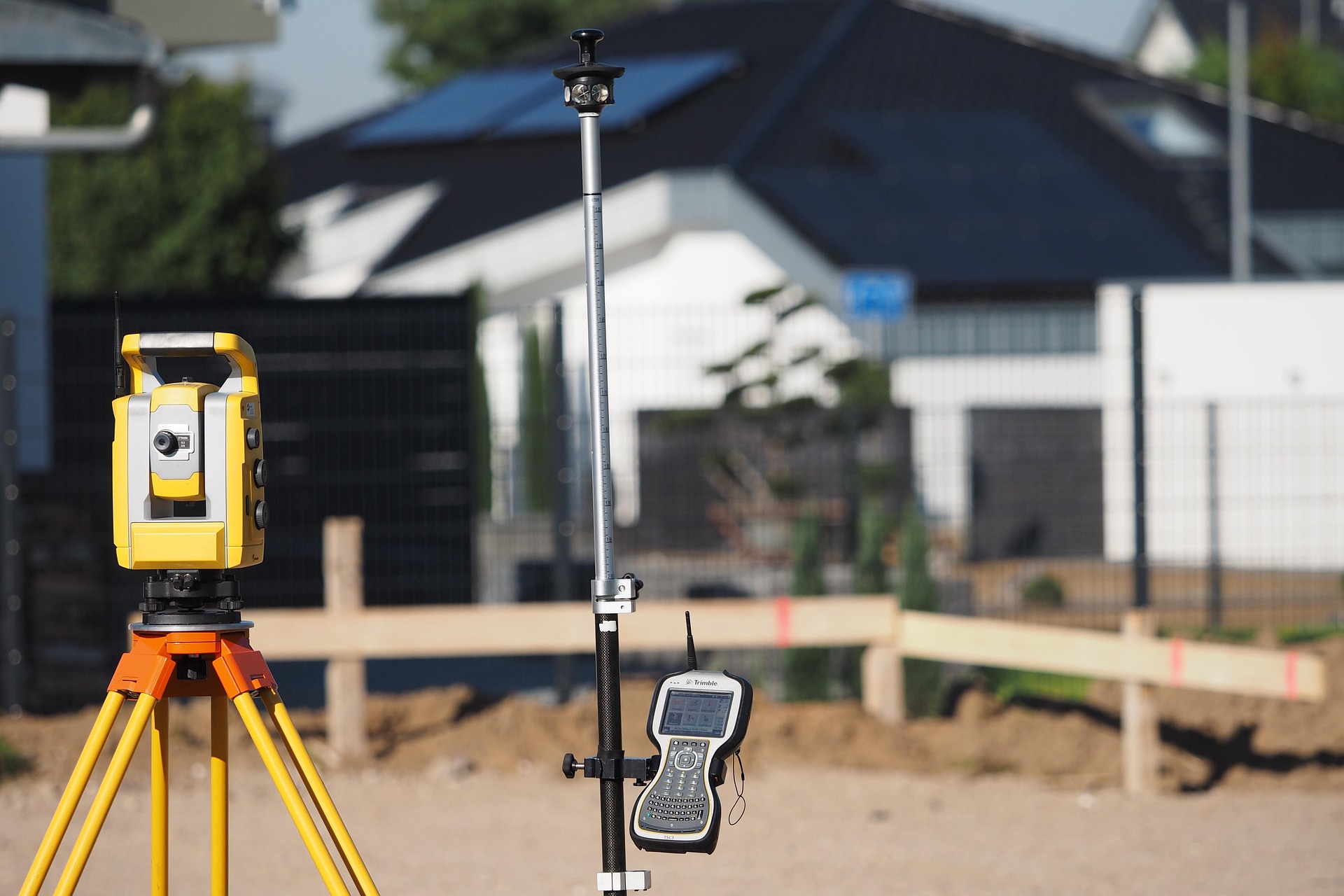
Introduction
The measurement of distances in 3D spaces is of great importance for the planning, monitoring, and execution of construction projects. Different methods for distance measurement offer varying advantages and disadvantages depending on the application context. This article presents the most important methods and explains their practical relevance.
Key Methods for Distance Measurement
Euclidean Distance
The Euclidean distance is one of the most commonly used distance metrics. It measures the direct straight-line distance between two points in space. This method is simple to calculate and understand, but becomes less meaningful in higher dimensions, as the differences between nearest and farthest data points become more uniform.
- Application: Frequently used in machine learning methods such as K-Nearest Neighbors (KNN)
- Advantage: Simple to calculate and understand
- Disadvantage: Less meaningful in higher dimensions
Wasserstein Distance (Earth Mover's Distance, EMD)
The Wasserstein distance, also known as Earth Mover's Distance (EMD), is a metric for measuring the difference between two probability distributions. It is often used in image processing and machine learning. The Wasserstein distance represents the minimum "work" required to transform one distribution into another, making it particularly useful for applications where the distribution of data points matters.
- Application: Image processing, machine learning — especially when working with distributions
- Advantage: Symmetric and well-suited for non-overlapping distributions
- Disadvantage: Computationally intensive
Chamfer Distance
The Chamfer distance is often used as an efficient alternative to the Earth Mover's Distance, particularly in applications where computational cost is a factor. It is less computationally intensive than EMD and is frequently applied in computer graphics and machine vision.
- Application: Computer graphics, machine vision
- Advantage: Less computationally intensive than EMD
- Disadvantage: Less accurate than EMD
Manhattan Distance
The Manhattan distance, also known as the L1 norm, measures the distance between two points along the axes of a grid. It is particularly useful in applications where movement along axes is relevant — for example, in urban environments with block structures.
- Application: Urban planning, navigation
- Advantage: Simple to calculate, particularly useful in urban environments
- Disadvantage: Less accurate for complex 3D structures
Minkowski Distance
The Minkowski distance is a generalization of the Euclidean and Manhattan distances and is used in normed vector spaces.
- Application: Normed vector spaces
- Advantage: Flexible through adjustment of the parameter p
- Disadvantage: More complex to calculate than Euclidean or Manhattan
Geodesic Distances
Geodesic distances are used in 3D computer graphics to relate features on a surface to one another. They account for the curvature of surfaces.
- Application: 3D computer graphics, medical imaging
- Advantage: Accounts for surface curvature
- Disadvantage: Complex to calculate
Directional Distance Field (DDF)
The Directional Distance Field is a newer method for measuring distances in 3D spaces that captures the local geometry of surfaces.
- Application: 3D modeling, computer graphics
- Advantage: Accounts for the local structure of surfaces
- Disadvantage: Newer method, less established
Further Relevant Methods
In addition to the methods described above, there are further relevant approaches for distance measurement in 3D spaces:
- Hausdorff Distance: Measures the maximum distance between two sets of points
- Mahalanobis Distance: Accounts for the covariance between variables and is useful for multivariate data analysis
- Cosine Similarity: Measures the angle between two vectors and is frequently used in text analysis and image processing
Prerequisites for Measurement
To apply these methods, certain prerequisites must be met:
- Data quality: High-quality and accurate data is essential for precise distance measurements
- Hardware: High-performance computers and specialized hardware can accelerate the calculation of complex distance metrics
- Software: Specialized software tools and libraries (e.g. GDAL, SciPy) are required to calculate and apply the various distance metrics
Application Examples
Construction Site Planning
In construction site planning, distance measurements are used to determine optimal locations for buildings, roads, and other infrastructure. The Euclidean distance and Manhattan distance are particularly useful here, as they enable simple and fast calculations.
Engineering
In engineering, distance measurements are used for the planning and monitoring of construction projects. The Wasserstein distance and Chamfer distance are particularly useful, as they can account for complex 3D structures and distributions.
Conclusion
Choosing the right distance metric is crucial for the accuracy and efficiency of construction and engineering projects. The Euclidean distance, Wasserstein distance, Chamfer distance, Manhattan distance, Minkowski distance, and geodesic distances are the most important methods for distance measurement in 3D spaces. Each method has its own advantages and disadvantages, and the right choice depends on the specific requirements of the project.
Sources
- KDnuggets - Most Popular Distance Metrics Used in KNN
- Towards Data Science - Spatial Distance and Machine Learning
- Wikipedia - Earth mover's distance
- Wikipedia - Wasserstein metric
- John D. Cook - Earth mover's distance
- Arize AI - Wasserstein Distance
- Mathematics Stack Exchange - Divergence between Probability Distributions from Samples via the Chamfer Distance
- GraphCalc - 3D Distance Calculator
- MIT - Geodesic Distances
- arXiv - Measuring the Discrepancy between 3D Geometric Models using Directional Distance Fields